Industrial IoT deployments generate extraordinary volumes of data. A single modern manufacturing facility can produce tens of millions of sensor events per day – temperature readings, vibration signatures, flow rates, pressure values, power consumption metrics, and quality measurements. The challenge has never been collecting this data. The challenge is making it useful alongside the business data that gives it operational meaning.
Microsoft Fabric has become the platform of choice for enterprise analytics in industrial organisations. But until recently, the sensor data that powers operational intelligence sat outside Fabric – in Azure IoT Hub, in proprietary historians, or in time-series databases – connected to the platform through complex, brittle pipelines. That has changed. This article explains how, and what it means for organisations building Industrial IoT (IIoT) analytics at scale.
Why Industrial IoT and Microsoft Fabric Belong Together
The case for unifying IIoT data with enterprise data in a single platform is not primarily technical. It is operational. The questions that matter most to industrial leaders – Why did this line go down? What is the real cost of this equipment’s downtime? Which process parameters predict quality failures three hours before they occur? – cannot be answered from sensor data alone.
Answering those questions requires correlating IoT telemetry with maintenance records from ERP, production schedules from MES, procurement data, financial cost centres, and workforce data. That correlation, at scale and in near real time, is exactly what Microsoft Fabric was built to enable. The missing piece has been getting sensor data into Fabric in a way that preserves its timestamp precision, its asset context, and its operational meaning.
The Architecture Challenge: IoT Data at Industrial Scale
Industrial sensor data has characteristics that make it challenging to integrate with enterprise analytics platforms:
Volume and velocity
A single OPC-UA historian might log 50,000 tags at one-second intervals. A plant with multiple process units can generate billions of data points per day. Standard ETL pipelines designed for transactional data buckle under this load – and even when they scale, they introduce latency that makes near-real-time analytics impossible.
Timestamp precision and time-series structure
Industrial sensor data is inherently time-series. Values only make sense relative to each other over time. Data models that work for transactional records – rows and columns in a data warehouse – do not naturally accommodate time-series structure without specialised handling. Forcing IoT data into a generic Lakehouse schema often means losing the query patterns that make operational analytics useful.
Asset context and engineering metadata
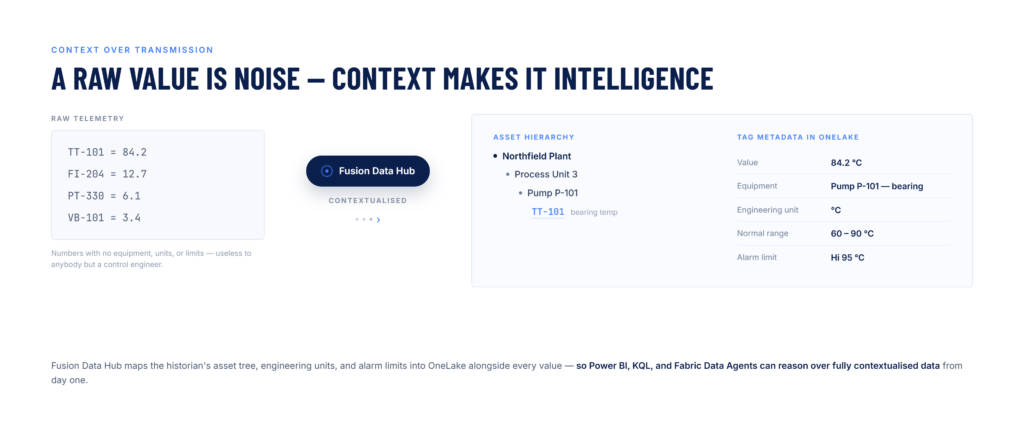
A raw sensor value is nearly meaningless without context: what equipment it came from, where that equipment sits in the plant hierarchy, what engineering unit it is measured in, what its normal operating range is, and what alarms or events occurred around it. This metadata lives in the historian or SCADA system. When IoT data is extracted without it, much of the analytical value is lost in transit.
Real-time requirements
Many industrial analytics use cases – condition monitoring, process optimisation, energy management – require data that is seconds or minutes old, not hours. Traditional batch ETL pipelines cannot meet this requirement. The architecture must support streaming ingestion alongside historical analysis, and must write to a query engine capable of real-time response.
Fabric-Native IoT Workloads: How the Architecture Actually Works
The Microsoft Fabric Extensibility Toolkit introduced a workload model where third-party applications run inside Fabric as first-class workspace items – sharing OneLake storage, Entra ID security, and Fabric compute without requiring data movement between systems.
For industrial IoT, a native Fabric workload changes the integration architecture in four specific ways:
Sensor data flows to OneLake and Eventhouse
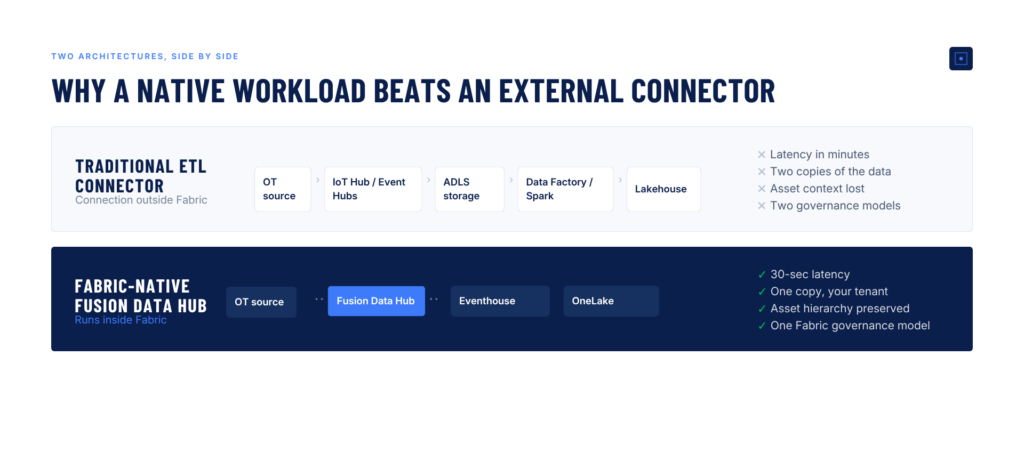
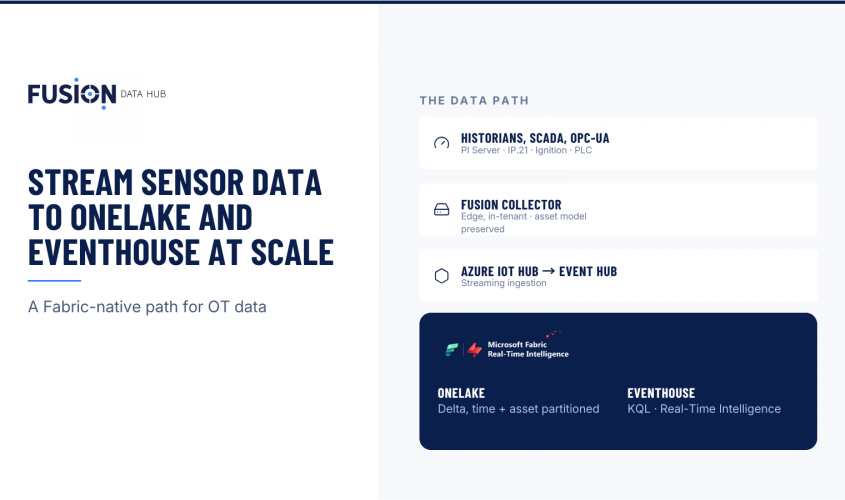
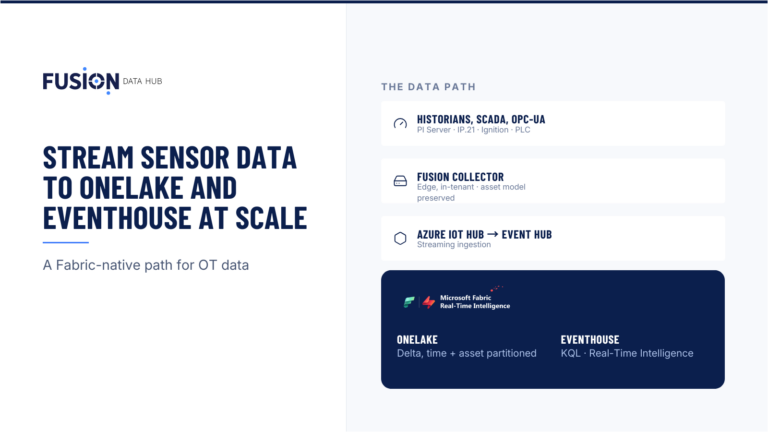
We route OT data from the Collector -> Azure IoT hub -> Event hub -> Fabric OneLake for historical analysis and to Fabric Eventhouse for Real-Time Intelligence. The data path is shorter, the latency is sub-second, and the data governance is simpler because there is only one place where your sensor data lives.
Time-series data modelled for Fabric analytics
Purpose-built industrial workloads like Fusion Data Hub organise IoT data in OneLake using schemas optimised for time-series queries – Delta Lake format, partitioned by time and asset hierarchy, with engineering unit metadata, alarm context, and equipment templates embedded alongside the values. This means Spark notebooks, Fabric Warehouse queries, KQL queries on Eventhouse, and Power BI reports all work against the same data without format conversion.
Real-Time Intelligence on live sensor streams
Because Fusion Data Hub writes streaming data directly into Fabric Eventhouse, Real-Time Intelligence dashboards are always up to date. KQL queries run on live operational data. Fabric Data Activator rules monitor conditions and fire alerts on events like process deviations, equipment state changes, or quality threshold breaches – using the same alerting engine that monitors your business data.
Asset model preservation and tag-level governance
Generic IoT connectors flatten sensor data into rows, losing the hierarchical context that makes it useful. Fusion Data Hub ingests the full asset model from your source – PI AF structure, IP.21 hierarchy, OPC-UA address space – and preserves it in OneLake as queryable structured data. Tag-level filtering lets you publish only the signals your analytics need, with governance applied per tag, per group, or per asset branch.
Industrial IoT Analytics Use Cases on Microsoft Fabric
When IIoT sensor data lives natively in OneLake alongside enterprise data, and flows in real time to Eventhouse, a new category of analytics becomes possible. The following use cases represent the highest-value applications industrial organisations are building on Microsoft Fabric today.
Predictive maintenance at scale
Correlating vibration, temperature, and current draw from rotating equipment with maintenance history from ERP and parts inventory from procurement – all in a single Fabric environment – enables predictive maintenance models that reflect the economic reality of maintenance decisions, not just technical signals from sensors. Fabric Data Science provides the training environment; Fabric Data Activator triggers work orders when model confidence crosses thresholds.
Energy and emissions management
Energy consumption is one of the largest controllable cost items in manufacturing and heavy industry. Native IoT integration enables near-real-time energy dashboards combining metered consumption from sub-meters and smart devices, production throughput from MES, carbon factor data from environmental tables, and cost data from finance – giving energy managers the full picture in one Power BI report, with Real-Time Intelligence alerts when consumption deviates from forecast.
Process quality and yield optimisation
Quality failures in continuous and batch processes often have leading indicators in process data that precede the quality event by hours. When historian time-series, batch recipe data, quality lab results, and equipment state all live in OneLake, Fabric Data Science can build models that identify these indicators – and Fabric Data Agents can surface them to operators in natural language through Fabric IQ.
OEE and production performance monitoring
Overall Equipment Effectiveness (OEE) is the standard KPI for manufacturing performance. Calculating it in near-real time requires combining downtime events from SCADA, production counts from line sensors, and quality rejection data – sources that rarely live in the same system. With sensor data streaming to Eventhouse and context preserved from the historian asset model, real-time OEE becomes a solved problem, not a data engineering project.
“We combined 4 million sensor events per hour with our ERP maintenance data in Fabric – our predictive maintenance model’s false positive rate dropped by more than half once it had the enterprise context.” — Upstream energy operator |
Real-World Deployments: Manufacturers and Energy Companies on Fabric
One of the most instructive deployments comes from Chevron. Like many industrial operators, Chevron struggled with operational data that was hard to find, hard to access, and often inconsistent or incomplete across business units. To put its time-series data to work for data scientists and engineers, Chevron needed a way to move OT data out of its on-premise historians reliably, securely, and at scale – and to standardise it once it landed in the cloud.
Working with Fusion Data Hub and Microsoft, Chevron built what its team calls a data superhighway. Fusion connects to OSIsoft PI and transfers PI history, AF asset models, tag metadata, and live stream data into Azure, where it is synchronised to Chevron’s enterprise data lake for analysis, trending, and updating at scale. Fusion solves the long-standing problem of extracting time-series data cost-effectively while minimising security risk and delivering it reliably into the customer’s own Azure tenant. As Chevron Chief Data Officer Ellen Nielsen put it, “By teaming with Fusion and Microsoft to connect and also automate the complex data, we are able to unlock the insights to help Chevron deliver on higher returns and lower carbon for our energy future.” Read more about Chevron’s journey here. The result is uncompromised, complete OT data made available across the enterprise – the same pattern Fusion Data Hub now delivers natively into OneLake and Eventhouse on Microsoft Fabric.
Key Benefits for Data Architects and Transformation Leads
- Single platform for OT and IT analytics. One data estate, one security model, one governance framework. Purview sees everything.
- Real-Time Intelligence on sensor streams. KQL, Eventhouse, and Data Activator work on live IoT data with sub-second latency.
- Preserved asset context. PI AF hierarchy, 21 models, and OPC-UA address spaces carry through to OneLake as queryable structure.
- AI-ready sensor data. Fabric Data Agents and Fabric IQ reason over operational and enterprise data in a single context.
- GA and certified. Listed on Microsoft AppSource, supported through the standard Fabric ecosystem.
What to Look for in an Industrial IoT Fabric Workload
Not all IoT integrations for Microsoft Fabric are built equally. When evaluating options, industrial organisations should ask:
- What source systems does it support? Look for production-ready support for the historians and SCADA systems your organisation actually runs: PI Server, IP.21, Honeywell PHD, Siemens, Ignition, and OPC-UA.
- Does it preserve asset hierarchy and metadata? Flat rows of sensor values without context are a dead end for analytics. Confirm the workload ingests and maintains your asset model.
- How does it integrate with Eventhouse and Real-Time Intelligence? Streaming ingestion to Eventhouse is what unlocks sub-second analytics and Data Activator alerting. Batch-only workloads cannot deliver this.
- Is it GA and on Microsoft AppSource? GA certification means the workload has passed Microsoft’s security and quality review. Preview-only integrations carry implementation risk.
- What governance features does it support? Tag-level filtering, Purview integration, and Entra ID inheritance are the minimum for enterprise deployments.
Is Your IIoT Environment Ready for Microsoft Fabric?
Before scoping an implementation, it is worth understanding whether your current IIoT environment is Fabric-ready. We have put together a free checklist covering source inventory, data volume estimation, network topology, and governance prerequisites.
Unify Plant Data with Fabric – Start Here
Fusion Data Hub is the only GA industrial analytics workload built natively on Microsoft Fabric. It is certified, listed on Microsoft AppSource, and in active deployment with top-tier manufacturers and energy companies. Evaluate it against your environment in a free 30-minute assessment. Our team will audit your IIoT sources, map them to a Fabric architecture covering OneLake, Eventhouse, and Real-Time Intelligence, and give you a custom scope, capacity estimate, and implementation timeline at no cost. Click for a free trial.
Getting Started
Fusion Data Hub workload is now available in Fabric and can be deployed from within the customer’s Fabric tenant via native workload configuration.
Learn more: https://www.fusiondatahub.com/fusion-in-fabric
Documentation: https://docs.fusiondatahub.com/fabric
Request a demo: https://www.fusiondatahub.com/contact
Fusion Data Hub workload on Fabric link: https://app.fabric.microsoft.com/workloadhub/detail/FusionDataHub.Fusion.Fusion?experience=fabric-developer